Ixana · Silicon
Wi-R NFE — XA-NFE3001
A gen-2 the pipeline asked for: 13.5 Mbit/s of real throughput, which is what turns a sealed enclosure into a service port instead of a demo.
In production- 20 Mbit/s PHY, ~13.5 Mbit/s real throughput — the announcement's figures
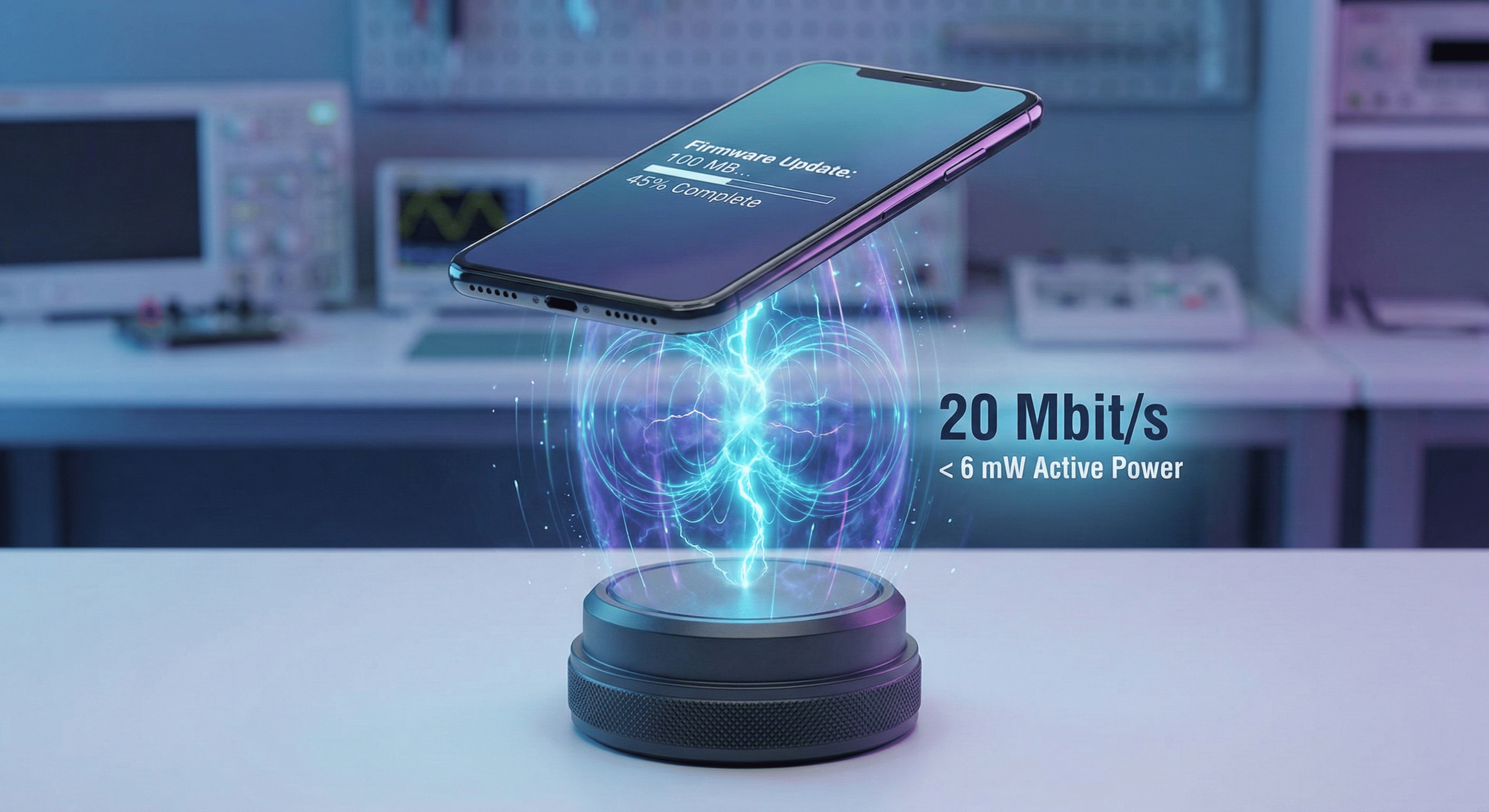
- 100 MB in about 59 s: inside the one-minute service window
- RF-silent; the Faraday-cage limit is in the datasheet, in writing
They were one number.
Problem. XA-NFE2001 opened the near-field line and then kept losing the same argument. Fourteen evaluations reached a requirement sheet and stopped, and reading those sheets against our characterisation data showed why: partners were sizing real payloads, and at gen-1 throughput a 100 MB firmware image took nearly four minutes.
What I did. I ran the review that turned those requirement sheets into the gen-2 specification. This spin was pulled by a pipeline we could name rather than pushed by a roadmap, so the requirements were somebody else's document and my job was to hold scope to what those documents actually said.
Result. Real throughput went from about 3.4 to 13.5 Mbit/s — the announcement’s own figures — putting a 100 MB payload inside a one-minute service window. Gen-1 stayed in production for designs needing its longer reach, so the upgrade stranded nobody. The pipeline that pulled this spin, and what converted, is the worked example below.
01Why this, and why now
The case for this spin was unusual: I did not have to make it. Fourteen evaluations had already written down what they needed and told us we did not meet it — demand documented, quantified and sitting in a folder. My job was to stop us spending it on something else.
The alternative was a gen-1 derivative for a new consumer segment — cheaper, lower rate, high volume. A real opportunity, with the property that makes speculative markets seductive: nobody can prove the number wrong. The pipeline number was written by people who had already qualified the part.
Timing mattered too: sealed enclosures were becoming the default across industrial and medical hardware just as firmware images crossed a hundred megabytes, so the gap between what a near-field link could carry and what a service workflow needed was widening on its own.
02The problem as people experienced it
Fourteen evaluations had supplied a written requirement sheet before stalling, so rather than interview anyone I put those sheets beside our gen-1 characterisation data and scored each line met or missed. Requirement sheets are the most honest artefact a partner produces: written to be held to, before anyone is invested in the answer.
| What the sheets asked for | Where gen-1 landed | How many asked |
|---|---|---|
| 100 MB payload inside a service window | About 235 s — nearly four minutes | 11 of 14 |
| Goodput of 10 Mbit/s or better | About 3.4 Mbit/s real throughput | 9 of 14 |
| Sub-millisecond latency | Met, comfortably | 12 of 14 |
| Operation at 1–5 cm through a sealed wall | Met, but tuned for longer range than asked | 8 of 14 |
The reframe: we had been reading these as separate objections and answering them separately. They were one number. Nobody wanted a faster link for its own sake; they wanted a payload moved inside a window a technician would stand still for.
03My role and approach
On this programme the delivery loop did the product definition outright. The founder owned whether the near-field line deserved a second part; I ran the review that decided what it had to be, converting the gap between fourteen requirement sheets and our characterisation data into a specification the design team could work from.
That is a narrower job than it sounds, and the discipline is in the refusals. A requirements list assembled from partner documents is easy to defend and easy to inflate, because every line has a customer name behind it.
Key decisions
- Specify to the sheets, not to the roadmap. Every requirement in the gen-2 spec traces to a line in a partner document scored as missed. Anything we merely thought would be good was out of scope.
- Buy throughput with range. Gen-2 runs 1–15 cm where gen-1 spanned 5–25 cm. The sheets asked for 1–5 cm through a sealed wall, so the range we gave up was range nobody in the pipeline used.
- Design to goodput, not to PHY rate. The number a partner plans a workflow with is real throughput. Specifying 20 Mbit/s PHY and reporting 13.5 Mbit/s goodput keeps the honest figure the headline one.
- Gen-1 stays, and stays supported. The upgrade could not strand sockets already shipping. Designs that need 25 cm keep buying the part that reaches it.
04What I cut
Shipped in v1
- 20 Mbit/s PHY, about 13.5 Mbit/s real throughput
- Sub-0.2 ms latency
- 1–15 cm operating range
- Under 6 mW active at full rate
- Host interface and reference driver shared with gen-1
Deferred
- Second host interface option
- Per-profile power tuning exposed to the host
- Reduced-rate low-power bin
Cut
- Operation through fully conductive enclosures
- On-die presence classification
- Runtime-adjustable range
Operation through a fully conductive enclosure was the hardest thing to refuse, and the most asked for — industrial partners with metal housings wanted the sealed-service story their plastic-cased neighbours were getting. It is not a scheduling constraint: an enclosed conductive shield blocks electric-field coupling, so the only route was a second inductive front end beside the electric one — die area, a second validation campaign, and the RF-silent property that is why these buyers are here. Enclosure-material guidance and an aperture pattern in the reference layout cover the partly-conductive cases; the datasheet says plainly a full Faraday cage is out of scope.
05How I got it agreed
The founder wanted the gen-1 consumer derivative instead. His reasoning was not casual: a cheaper low-rate part aimed at a high-volume consumer tap has a bigger ceiling than any industrial pipeline, and a company that only serves the customers it already has stops finding new ones. He has been right about that before.
Arguing about which market was larger was unwinnable — the honest answer is his. So I compared the quality of the two numbers instead. The pipeline 480 thousand were written by partners into their own requirement sheets after qualifying the part; the derivative 200 thousand were ours. Which opportunity is bigger became which number we would still believe in a year.
He agreed, and attached a condition. The gen-2 spin had to carry the hooks the derivative would need — a documented reduced-rate, low-power operating point selectable at provisioning — so the derivative becomes a binning decision rather than a third spin. It cost unbudgeted validation weeks, and it is why a derivative is now a quarter of work instead of a year.
06What was built
A near-field transceiver moving about 13.5 Mbit/s of real data at 1–15 cm, under 6 mW, sub-0.2 ms, with no radiated RF. In workflow terms: 25 MB in about fifteen seconds, 50 MB in thirty, and a 100 MB firmware image plus validation logs in fifty-nine — the number that decides whether a sealed device can be serviced unopened.
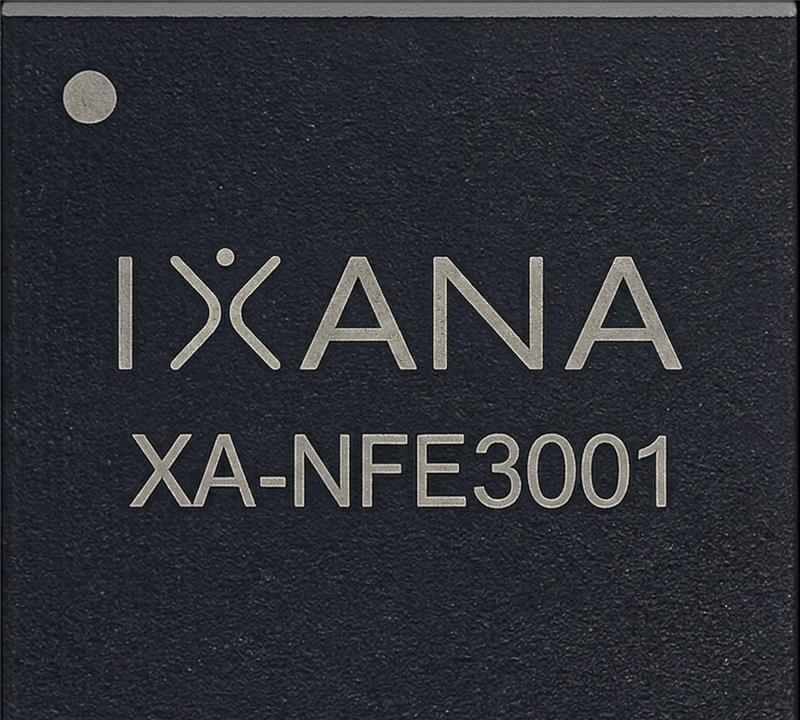
- 1Same host interface and driver as gen-1. A partner already evaluating XA-NFE2001 moves without a firmware project, which is what makes the installed base an asset rather than a migration to manage.
- 2Full part number on the package face. Two NFE parts now ship concurrently with different range envelopes. A design that reads the wrong marking builds against the wrong specification.
- 3Range tuned for 1–15 cm, not gen-1's 5–25. The trade the requirement sheets licensed. Tighter coupling is what the throughput was bought with, and nobody in the pipeline was using the range we gave up.
- 4No second front end for metal enclosures. The cut in section 04, visible as an absence. Adding one would have cost the RF-silent property these buyers came for.
Ixana XA-NFE3001 package, from Ixana's published product photography. The package, part marking and specification are public; internal design detail is not shown. Happy to walk through the real programme in a conversation.
07Tradeoffs
| Tension | What I chose | What it cost |
|---|---|---|
| Throughput vs range | 1–15 cm instead of gen-1's 5–25 cm | Any design wanting distance stays on gen-1 permanently |
| Documented pipeline vs new segment | Serve the fourteen; carry hooks for the derivative | Validation weeks on an operating point nothing ships against yet |
| Scope discipline vs partner goodwill | Only requirement lines scored as missed | Reasonable asks declined with a customer's name attached to each |
| Coverage vs the RF-silent promise | No inductive front end for metal enclosures | A whole class of industrial housing is out of scope, in writing |
08Impact and outcomes
Before the spin was committed we agreed it failed on one condition: if gen-2 could not move a 100 MB payload inside a one-minute service window on partner hardware, the sealed-service workflow stayed theoretical. Gen-1 socket retention was the guardrail — the upgrade was not to be won by stranding designs that had already chosen us.
How we counted. Throughput is goodput at the host application, not PHY rate: payload bytes delivered divided by wall-clock session time, including link establishment. A converted evaluation issued a design commitment against gen-2 — a purchase order or a schematic we have seen — so evaluations that merely restarted are excluded, and nine is smaller than the enthusiasm suggested. The fourteen are gen-2 conversions of evaluations that had already stalled on gen-1 — fourteen of the same 26 NFE-line evaluations the gen-1 page counts, not a later intake.
Part configuration — XA-NFE3001 Wi-R NFE transceiver · 20 Mbit/s PHY, ~13.5 Mbit/s goodput · under 6 mW active at full rate · 1–15 cm operating range · sub-0.2 ms latency · RF-silent electric-field coupling · not intended to couple out of a fully enclosed conductive shield · host interface and reference driver shared with XA-NFE2001
09What I'd do differently
I treated the requirement sheets as a specification and never asked what was missing from them. They told me precisely what the fourteen wanted and nothing about partners who never wrote one — and the metal-enclosure request in section 04 came from exactly that population, late, by which point it was a physics answer rather than a design question.
I would also have set the service window with a margin. Fifty-nine seconds against a sixty-second requirement is a specification met and an engineering position with nowhere to stand: any partner whose enclosure attenuates more than our reference case falls outside a window we told them we were inside.