Ixana · Silicon
Wi-R NFE — XA-NFE2001
The second product line: a touch-range electric-field link at 5 Mbit/s under a milliwatt, sold against NFC rather than against Bluetooth.
In production- 5 Mbit/s under a milliwatt — the public spec
- Over 50× NFC energy efficiency — the published comparison
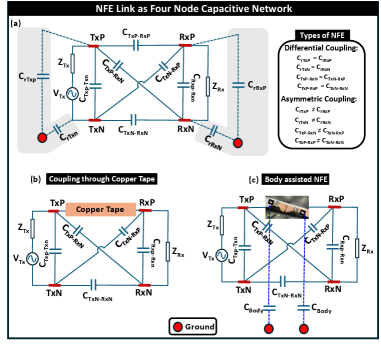
- The physics written up on arXiv: 2512.07167
Choosing the comparison is choosing the buyer.
Problem. One product line makes a company a bet. Wi-R had proven itself on the body, and the demand arriving through the front door was increasingly not body-worn — device-to-device, at touch range, from buyers who had already rejected NFC on throughput and Bluetooth on emissions.
What I did. The founder owned the bet that a near-field line should exist. I owned turning it into a delivered part while the BAN program kept its dates: shared validation capacity, a scope built for a different buyer, and launch gates for a part that had to work on hardware we did not design.
Result. XA-NFE2001 launched at 5 Mbit/s under a milliwatt — over 50× NFC’s energy efficiency and ten times its throughput, per the published comparison — with the physics written up in an arXiv paper. It shipped as a second line while BAN kept its dates; the interop matrix that qualified it is the worked example below.
01Why this, and why now
The commercial question was whether Ixana was a one-line company. A single line makes every investor and large-customer conversation about concentration risk, and puts one thing on the roadmap. A second line answers both — and a second line that slips adds an execution problem to the concentration risk.
The buyers were already there, and they were not asking for a body-area network. A secure-payments device maker and an industrial-handheld OEM wanted the same thing: move a firmware image between two devices held near each other, without an exposed port and without lighting up a radio. Their incumbent was NFC, and what they disliked was the clock.
That chart is the argument for a second line. Neither incumbent is bad; each is bad at a different half of a transaction these segments perform hundreds of times a day.
02The problem as people experienced it
I did not run a study for this one. I coded eighteen months of inbound evaluation requests by what the sender actually wanted to do, because a request for a body-area part from someone describing a payment terminal is a demand signal for something we had not built.
| What they asked for | What they described wanting | Evidence |
|---|---|---|
| A BAN evaluation kit | Two devices touching, no body involved | 31 of 96 inbound requests |
| "Something like NFC but faster" | Firmware and log transfer at touch range | 22 of 96; the largest single ask |
| Range figures for a non-worn case | Device-to-device at 10–20 cm | 19 of 96 asked for off-body range |
| A part with no radio emissions | Provisioning inside an RF-quiet facility | 14 of 96, concentrated in defence and industrial |
The reframe: we had been reading this as poor qualification by the sales team. It was demand for a different part, arriving in the only vocabulary available to people who had seen one page of our website.
03My role and approach
The split is the same as on the BAN program: the founder owned the bet that a near-field line should exist and what it was for; I owned the delivery system that made it a part — the same five functions across two sites, now running two silicon programs against one pool of validation capacity.
Running two lines is where delivery fed product hardest. Shared validation capacity forced the range decision below, and the interop matrix we could afford set how configurable the part could be. Those were settled as scheduling questions, and they shaped the datasheet.
Key decisions
- Make the second line boring wherever it can be. Host interface, driver model, provisioning flow and test fixtures were reused from BAN rather than redesigned. A second line proves the company only if it arrives on time.
- Three characterised range profiles, not a continuous knob. Range is the NFE product variable, and every extra setting multiplies an interop matrix somebody has to sit at a bench and run.
- BAN keeps its dates; NFE is scheduled into the gaps. With one validation pool and two programs, either both slip or one has priority. I made that explicit up front rather than discovering it in month four.
- Sell it against NFC, not against Bluetooth. Requests arrived describing NFC’s limits, so the datasheet, comparison figures and launch material all answer NFC. Choosing the comparison is choosing the buyer.
04What I cut
Shipped in v1
- 5 Mbit/s at under 1 mW
- Three characterised range profiles from 5 to 25 cm
- Sub-millisecond end-to-end latency
- RF-silent electric-field coupling
- Reference driver and provisioning flow shared with BAN
Deferred
- Higher-rate mode (became XA-NFE3001)
- Multi-device near-field grouping
- Second host interface option
Cut
- Runtime-adjustable range
- On-die presence classification
- Per-profile power tuning exposed to the host
Runtime-adjustable range was the hardest cut, and the one partners asked about most. A continuous knob the host could turn is obviously useful — tight for a payment, open for a bench transfer. It failed on validation capacity already split with BAN: every additional setting multiplies the interop matrix, and we could afford twelve configurations, not sixty. Three profiles cover the cases the inbound requests described; a partner needing a fourth gets it characterised in a later revision rather than finding at integration that nobody tested theirs.
05How I got it agreed
The COO would not commit a build plan for a second line on gen-1 demand signal. His objection was capital: committing wafer starts and package tooling for a part with no shipped revenue, on the strength of inbound emails, looks obvious beforehand and reckless in a quarter where BAN needs the same money.
I had been arguing that the demand was real, which is unfalsifiable and therefore useless. So I made it falsifiable: we converted the 96 coded requests into a sample-request commitment — before any long-lead spend, that population would formally request samples against a spec sheet with a price on it. Interest that survives a form and a price is a different signal.
104 requests came back — eight of the 96 companies asked from two teams, which is how 96 coded requests produce 104. He committed the build plan, with a condition I had not planned to offer: the second line gets its own line in the capital plan, so if NFE underperforms it is visible as NFE underperforming. Every subsequent conversation about a third line has been shorter for it.
06What was built
A near-field transceiver moving 5 Mbit/s between two devices at touch to decimetre range, under a milliwatt, sub-millisecond, with no radiated RF. It couples through a contained electric field rather than a magnetic one, which buys both the throughput and the range NFC lacks while keeping what buyers came for: nothing to intercept from across the room.
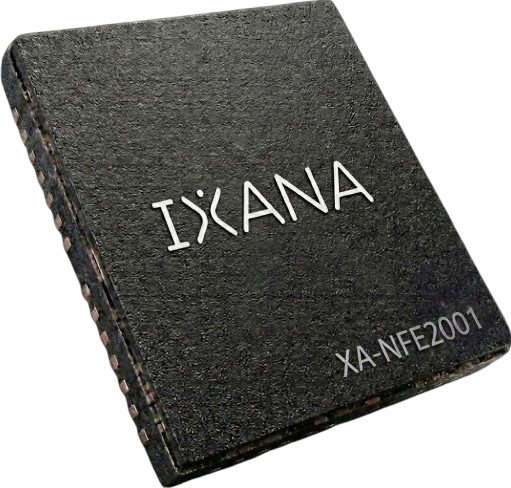
- 1Same host interface as the BAN part. A partner already evaluating BAN can bring this up against a driver they have. Reusing it cost us a cleaner interface design and bought a second line that shipped on schedule.
- 2Range is a provisioning-time profile, not a runtime register. The cut in section 04, visible in the part. Three profiles are characterised; a fourth would have been untested silicon wearing a tested part number.
- 3No antenna, no matching network on the reference layout. Electric-field coupling removes the component most likely to differ between our board and a partner's, which is where interop usually goes wrong.
- 4Marked as a distinct family, not a BAN variant. Internally it shares most of its lineage. Publicly it had to read as a second product line, because that was the argument the part existed to make.
Ixana XA-NFE2001 package, from Ixana's published product photography. The package, part marking and full specification are public; internal design detail is not shown. Happy to walk through the real program in a conversation.
07Tradeoffs
| Tension | What I chose | What it cost |
|---|---|---|
| Second line vs BAN's dates | One validation pool, BAN holds priority | NFE waited on bench time repeatedly; the launch date was set by other people's queue |
| Configurability vs testable surface | Three range profiles, fixed at provisioning | The most requested feature is absent, and partners raise it in most first calls |
| Reuse vs a cleaner design | BAN's host interface and driver model carried over | The NFE part inherits interface decisions made for a different problem |
| Positioning against NFC vs against BLE | All material answers NFC | Buyers arriving from a Bluetooth frame have to be re-oriented before the comparison lands |
08Impact and outcomes
Before the build plan was committed we agreed the line failed on one condition: if the part could not hold a link across the majority of host and range configurations on hardware we did not design, it was a demo, not a product. The BAN program was the guardrail — a missed BAN milestone while the second line spun up meant NFE was being paid for out of the first.
How we counted. A configuration passes when 34 of 40 attempts establish and hold a link for ten seconds on hardware the partner built — the reference board is excluded deliberately, being the one platform guaranteed to work. Design-ins count NFE-line evaluations including direct silicon engagements, a wider population than the dev-kit page’s kit-mediated figure. Latency here is the 0.6 ms median on partner hardware; the 0.9 ms on the XA-NFE3001 page is the worst-case characterisation figure a requirement line is scored against.
Part configuration — XA-NFE2001 Wi-R NFE transceiver · up to 5 Mbit/s · under 1 mW at full rate · three provisioning-time range profiles across 5–25 cm, up to 1 m at reduced rate · sub-1 ms end-to-end latency · RF-silent electric-field coupling · host interface and reference driver shared with the BAN line
09What I'd do differently
I let the interop matrix be sized by what we could afford rather than where risk was. Twelve configurations was a capacity number, not an analysis, and the cell that failed was predictable from first principles — slowest host, longest range. An hour of thinking would have spent the same twelve slots on the twelve riskiest combinations instead of a tidy four-by-three grid.
I would also have run the sample-request test earlier. It settled section 05 in a fortnight, and I reached for it only after two months of arguing that demand was real. The instrument that turns an unfalsifiable claim into a number is usually cheap.