Ixana · Developer hardware
Wi-R dev kits — BAN YR23 and NFE XA-NFE2001
Turned two pieces of evaluation silicon into a kit a partner engineer can unbox and get an on-body link running the same day.
In production- Shipping kit, sold through the public product page
- One number on the box: time to first link
- Both Wi-R families — BAN first, NFE on shared tooling
It is the only metric sales, engineering and I argued about in the same units.
Problem. Wi-R worked in our lab and almost nowhere else. Every partner evaluation began with their engineer reproducing a body-coupled link from a datasheet, and the first six took a median of 28.5 days — most of it spent on electrode placement and grounding rather than on evaluating the technology.
What I did. I ran the dev kit program across both Wi-R families, defining the kit as the smallest object that produces a working link on day one, sequencing BAN before NFE, and trading configurability away for a fixed electrode geometry a partner could not get wrong.
Result. The kit ships through the public product page, and its whole design is the removal of variables: a fixed, characterised electrode geometry, a known-good host board, a hard power switch, the part number printed on the case. The volumes, timings and conversion figures further down are the worked example the programme was run against — including the pre-agreed floor that would have killed it.
01Why this, and why now
Three ways of getting Wi-R into partner hands were on the table for the year: an onsite bring-up by our applications engineer, a full reference design, or a dev kit. The commercial stake was concrete — our largest pipeline evaluation, a hearables OEM weighing Wi-R against BLE for an earbud-to-case link, had said plainly they would not staff an RF engineer to evaluate an unproven physical layer. If evaluation stayed expensive we lost the account, and the reference design every later hearables conversation would lean on.
I sized the three against the constraint that actually bound us: applications engineering capacity. Three engineers could bring up a body-coupled link, and each option consumed them differently.
The reference design lost on timing rather than merit — it answers "how do I productise this", and nobody reaches that question before believing the link works.
02The problem as people experienced it
I timed the first six partner evaluations end to end, from silicon delivery to first sustained link, and audited the 41 support tickets they generated. The failures clustered tightly, and almost none were about the radio.
| What they did | Where it broke | Evidence |
|---|---|---|
| Wired the transceiver to their own MCU | Clock and supply noise coupled into the electrode path | 5 of 6 evaluations; 11 tickets |
| Improvised electrodes from copper tape | Contact area and spacing off by enough to kill the link | 6 of 6; 15 tickets — the single largest time sink |
| Grounded the board to bench earth | Return path through the bench, not the body | 4 of 6; 9 tickets, all filed as "no link" |
| Measured with a scope probe on the electrode | Probe capacitance loaded the node and hid the signal | 3 of 6; 6 tickets |
The reframe: this was never an RF documentation problem. Every partner failed on the two things invisible in a datasheet — electrode geometry and return path. A better datasheet would have moved nothing; a fixed, tested electrode assembly moved everything.
03My role and approach
I ran the kit program end to end: what went in the box, what the first hour had to prove, which silicon shipped first, and what we would refuse to make configurable. I ran the program across hardware, firmware and applications engineering, and held the boundary with sales on what a kit was allowed to promise.
Key decisions
- Fixed electrode geometry, not an electrode kit. The obvious build was a bag of options so partners could explore. Exploration was where they lost three weeks, so the kit ships one dry and one gel pair at a tested spacing, documented rather than adjustable.
- BAN first, NFE one quarter behind. We could only qualify one at a time. BAN had the pipeline pressure and the harder bring-up, so it went first and paid for the tooling the NFE kit reused.
- A host board in the box, not a bring-your-own MCU. Half the observed failures came from partner-side clock and supply noise. A known-good host board meant a failed link was our fault, which made every ticket diagnosable.
- One number on the box: time to first link. The program's acceptance criterion was a partner engineer reaching a sustained link inside one working day, and I refused features that did not move it. It is the only metric sales, engineering and I argued about in the same units.
04What I cut
Shipped in v1
- BAN and NFE transceiver modules
- Known-good host board
- Dry and gel electrode pairs
- USB console with a link-health readout
- Two worked example applications
Deferred
- Second host board option
- Android companion app
- Multi-node topology examples
Cut
- On-kit display
- User-adjustable electrode mounting
- Battery-powered untethered mode
The on-kit display was the hardest cut. Every partner review asked for it — a screen showing link state lets you walk around and watch the link hold, which is the demo that convinces a room. It cost an enclosure revision, a display driver and about seven weeks. A host-side console prints the same link-health fields, which is a worse demo and an equal diagnostic — and the diagnostic is what an evaluation actually needs.
Out of scope for the first kit revision
- On-kit status display. Adds an enclosure revision and roughly 7 weeks to first ship. Same information available over the USB console. Revisit if console use falls below half of onboarding sessions.
- Adjustable electrode mounting. Directly contradicts the finding that geometry exploration is the largest single time cost. Fixed geometry, documented, no fasteners.
- Untethered battery operation. Needed for field demonstrations, not for evaluation. Moves to the reference design, where power budget is the point.
One page from the kit definition, with supplier and cost lines removed.
05How I got it agreed
The VP of Sales wanted the kit and the reference design bundled and sold as one thing. His reasoning was sound from where he sat: a kit is a small transaction that produces a technical opinion, a reference design is what a partner builds against, and shipping them together meant one conversation instead of two.
I did not think we would win on principle, so I re-grounded it in the pipeline we had. Every completed evaluation had asked a variant of “does this link hold on a person” before any productisation question — and bundling would put a two-month reference-design lead time in front of a question we could answer in a day. Deal size stopped being the argument; what the partner is trying to learn first became it.
He agreed, with two conditions I had not planned to give. The kit ships with two worked examples rather than one, demonstrating a use case and not just a link — three weeks of firmware time. And any partner completing a kit evaluation gets the reference-design files with no separate commercial step, so the kit never becomes a toll gate — which is why eval-to-design conversion is measurable at all.
06What was built
A sealed kit: a Wi-R transceiver module, a known-good host board, two tested electrode assemblies, a USB console and two worked applications. A partner engineer opens it, mounts the electrode pair as printed on the enclosure, connects the console, and watches a link establish across their own body inside the hour. Everything that could have been a variable — spacing, contact material, ground reference, host clocking — is fixed and characterised.
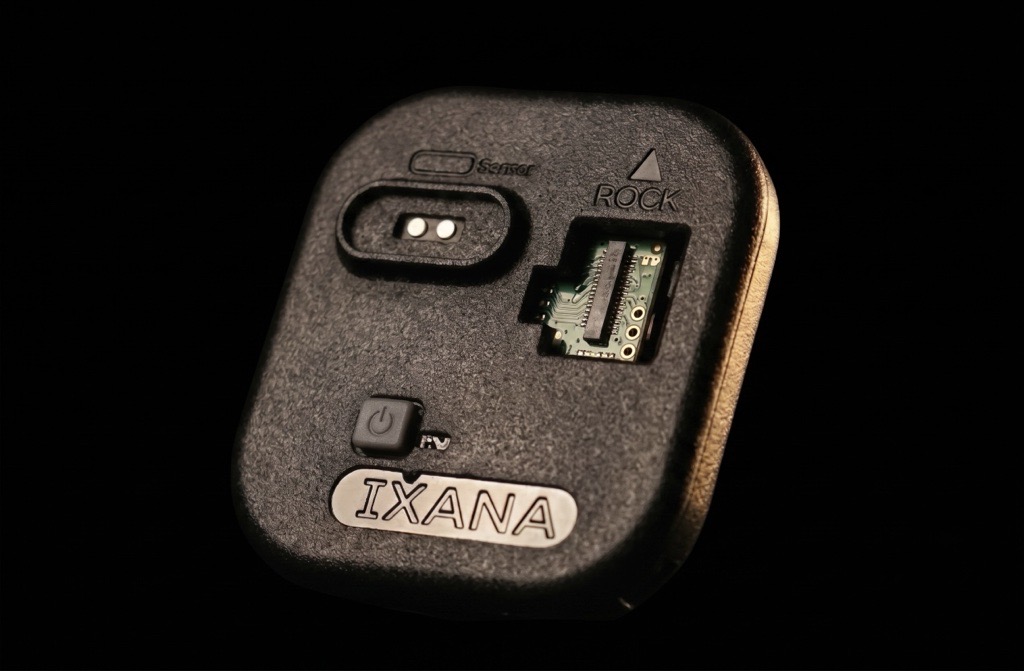
- 1The electrode port is keyed and labelled on the enclosure. Partners lost three weeks to geometry they could not see. Keying it means the one variable that killed six evaluations cannot be set wrong.
- 2The module sits in an open bay, not under a lid. Evaluators want to probe the module and swap silicon revisions. Leaving the bay open cost ingress protection we did not need on a bench.
- 3Power is a hard switch, not a firmware state. Half of the early "no link" tickets were resolved by a power cycle. A physical switch makes the first diagnostic step unambiguous over a phone call.
- 4The part number is on the outside of the case. Support threads kept stalling on which silicon revision a partner had. Printing it externally removed a round trip from most tickets.
Ixana dev kit enclosure, photographed in-house. The mechanical design and markings are public; internal boards are not shown. Happy to walk through a live bring-up in a conversation.
07Tradeoffs
| Tension | What I chose | What it cost |
|---|---|---|
| Configurability vs first-hour success | One fixed, characterised electrode geometry | Two partners with unusual form factors had to wait for a custom assembly, and one evaluation slipped a quarter |
| Kit cost vs diagnosability | Ship a known-good host board rather than expect the partner's MCU | Roughly a third of the bill of materials buys hardware most partners discard after evaluation |
| Speed to ship vs demo quality | USB console instead of an on-kit display | The kit demonstrates badly in a room full of executives, which sales absorbs on every first meeting |
| Two families vs one | BAN first, NFE a quarter later on shared tooling | NFE partners waited a quarter, and two of them evaluated a competitor in the interval |
08Impact and outcomes
Before tooling was committed we agreed the program failed on two conditions: fewer than 40 kits shipped in six quarters, or median time to first link still above three days after the second revision. RMA rate was the guardrail — a kit that ships fast and comes back is worse than no kit, because it spends the partner's goodwill rather than ours.
How we counted. Time to first link means the interval between the partner opening the box and their first sustained 60-second on-body link, self-reported in the onboarding form. It counts calendar time rather than engineering hours, because calendar time decides whether an evaluation survives a reprioritisation. A design-in counts only where the part appears in a partner schematic we have seen. The 34 evaluations are kit-mediated only, a narrower population than the NFE-line design-in figures, which include direct silicon engagements.
Kit configuration — YR23 BAN transceiver module rev C · XA-NFE2001 NFE module rev B · STM32U5 host board · dry and gel electrode pairs at fixed spacing · USB-C console at 921600 baud · kit firmware 2.4.1
09What I'd do differently
I measured the kit and never measured the evaluation. Time to first link was right for the hardware and wrong for the business: it says the box works, nothing about whether the partner reached a decision. Nine of 34 converted, and I cannot say cleanly why the other 25 stopped — we instrumented the first hour thoroughly and the following two months not at all.
I also let the NFE kit slip a quarter to reuse BAN tooling, and would take that trade differently now. The saving was real; the cost was two partners running a competitor evaluation in the gap, which does not appear in any program metric until it appears as a lost design-in a year later.