Ixana · Silicon
Wi-R BAN — YR31
The second spin: four times the rate and a fifth of the latency, bought with a deliberate step backwards on energy per bit.
In production- 20 Mbit/s · sub-0.2 ms — shipped silicon, on the public spec row
- Gen-1 kept in production beside it, so nobody was forced to move
- 0.12 → 0.20 nJ/bit spent deliberately to buy rate
The hard part was refusing changes.
Problem. YR23 shipped and sold, and its own deferred list was the roadmap: a higher-rate mode, and on-die trim storage. The field agreed. The video use case carrying the volume was rate-bound at 5 Mbit/s, and the bring-up friction YR23 documented — a manual trim pass on 19 of 24 boards — cost a week every time.
What I did. I ran the loop that decided what a second spin was for: routing field feedback, yield and test data from the YR23 lots into one ranked change list, and holding the line on what gen-2 would not attempt. The hard part was refusing changes.
Result. YR31 is in production at 20 Mbit/s and sub-0.2 ms across the same 16-device network — the public spec row carries every one of those numbers. Energy per bit went the wrong way on purpose, and gen-1 stayed in production beside it so no shipping design was forced to move. The yield, test-time and interop figures below are the worked example.
01Why this, and why now
A second spin is the easiest programme in the world to justify badly: everyone has a change they want, the die is proven, and the argument for going again is always available. The question was not whether to spin but what the spin was for — a gen-2 that absorbs every request is a gen-1 arriving eighteen months late.
The commercial stake settled it. The volume tier of the segment YR23 opened is video smartglasses, and at 5 Mbit/s that design compresses hard enough that compression becomes the product problem. Rate was the constraint holding back the only application with consumer volume behind it.
The other half came free. YR23’s deferred list already carried on-die trim storage, and the bring-up data said it was worth more than we had assumed. One spin could answer the rate ceiling and the friction together.
02The problem as people experienced it
I collected every change request, field issue and evaluation complaint against YR23 — 63 — and ranked each by two defensible numbers: stalled evaluations unblocked, and cost in die area and validation weeks. A list of 63 requests is an argument for a third spin; a ranking is a decision.
| What came back | What it cost them | Evidence |
|---|---|---|
| "We had to compress harder than planned" | Video quality became the integration problem | 9 of 63, all head-worn designs |
| "Every board needs a manual trim pass" | About a week added to each bring-up | 17 of 63; the most frequent single item |
| "Test cost is visible in our BOM" | Per-unit test time at volume | 6 of 63, all from teams past prototype |
| Assorted convenience requests | Real, individually small, collectively a second gen-1 | 31 of 63 |
The reframe: the loudest request was not the most valuable. Rate had executive attention because it appeared in competitive comparisons; on-die trim was raised nearly twice as often by the people actually building boards, and cost a third as much.
03My role and approach
This is the clearest case on the line of a delivery lens feeding product decisions. The founder owned whether a second BAN part should exist and what it was for. I ran the loop that fed that decision: routing field feedback, yield and ATE data from the YR23 lots into one ranked list, and defending the line under it.
The routing was deliberate. Field issues, evaluation complaints and lot data arrived through three channels to three audiences, and nobody scored them against each other — so I ran them into one queue and made the ranking the artefact everyone argued about.
Key decisions
- Three changes, ranked in public. Rate, on-die trim, test time. Everything else was published as ranked-and-declined rather than quietly dropped, which stopped the tail returning every month.
- Spend energy per bit to buy rate. Efficiency regresses from 0.12 to 0.20 nJ/bit. Absolute power stays inside the class that makes Wi-R viable, and the application carrying the volume needs rate more than efficiency.
- Cut the test program by evidence, not by target. Test time came out of tests that had never failed a unit across the YR23 lots, not out of a percentage handed down.
- Keep YR23 in production rather than replacing it. A gen-2 that obsoletes gen-1 forces every shipping design to requalify. Two parts on one line costs us inventory and buys customers the right to not move.
04What I cut
Shipped in v1
- Up to 20 Mbit/s with sub-0.2 ms latency
- On-die per-unit trim storage
- Reduced ATE test program
- Same 16-device network and range envelope
- Interop parity with the installed YR23 host base
Deferred
- Smaller package variant
- Multi-network coexistence
- Field-updatable PHY parameters
Cut
- Backward-compatible gen-1 energy mode
- Second host interface option
- On-die link encryption
The backward-compatible energy mode was the hardest cut. Partners with a shipping YR23 design wanted YR31 to run 5 Mbit/s at gen-1’s exact 0.12 nJ/bit — drop it in now, inherit the rate later, power budget untouched. It needed two separately tuned analogue front ends on one die: the area was findable, the validation was not, since every mode multiplies the characterisation matrix the spin had just reduced. The gap is covered twice — interop parity, and YR23 staying in production.
05How I got it agreed
The test lead objected to cutting the ATE program — the strongest objection anyone put to me on this programme. Test time at volume is a real line in a customer’s cost model, so pressure to cut it is permanent, and every test removed is a class of defect that now reaches a wearable on somebody’s head. A field failure is not a return; it is a design-in at risk.
I had opened by asking for a test-time target, which invited exactly the argument we were having. So I withdrew it and asked which tests had actually failed a unit across every YR23 lot. Roughly a third had never fired. That moved the conversation from how much test we could afford to which tests had earned their seconds — his question to answer, not mine.
He agreed to cut the tests that had never fired, on a condition I had not planned to carry. Every removed test is re-run as a periodic audit on a sample of lots, so if one starts failing we hear it from our own sampling rather than a customer. That process is permanent.
06What was built
The higher-rate part on the BAN line: 20 Mbit/s at sub-0.2 ms across the same up-to-16-device network, inside the same range envelope as gen-1, at under 6 mW. It carries per-unit trim on the die, so a board no longer needs a manual trim pass to reach a stable link.
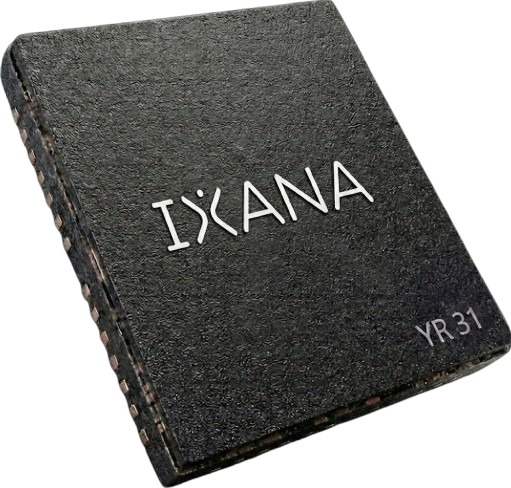
- 1Same package and pin-out as YR23. The change that made interop parity a promise we could keep, and the one nobody requested because nobody misses a problem they never had.
- 2Trim lives on the die, not in a procedure. Seventeen of 63 field items were the manual trim pass. Moving it on-die removed about a week from every board bring-up.
- 3Marked as a distinct part, not a revision. YR31 changes the energy point. Shipping it as a YR23 revision would have let a design inherit a different power budget without noticing.
- 4Runs the same reference driver. A partner evaluating gen-1 moves to gen-2 without a firmware project, which is what keeps the installed base an asset rather than a migration problem.
Ixana YR31 package, from Ixana's published product photography. The package, part marking and specification are public; internal design detail is not shown. Happy to walk through the real programme in a conversation.
07Tradeoffs
| Tension | What I chose | What it cost |
|---|---|---|
| Rate vs energy per bit | 20 Mbit/s at 0.20 nJ/bit | Gen-1 remains the better part for anything not rate-bound, permanently |
| Scope vs schedule | Three ranked changes; 31 requests declined in public | A standing queue of reasonable asks with no home until the next spin |
| Test coverage vs per-unit cost | Cut only tests that had never failed a unit | A lot-sampling audit process that must run forever to stay honest |
| Clean succession vs customer disruption | Keep YR23 in production alongside | Two parts, two inventories, two datasheets, one small team |
08Impact and outcomes
Before the spin was committed we agreed it failed on one condition: if gen-2 could not hold 15 Mbit/s sustained on a person, the video use case stayed blocked and the spin bought nothing that mattered. Interop with the installed YR23 host base was the guardrail — rate and cost were not to be won by breaking the customers gen-1 had earned.
How we counted. Yield is wafer-level probe yield at production release, excluding lots scrapped for assembly or handling defects, which are a packaging problem and would flatter the die. Interop is counted across the 34 host designs in the installed base: the failing 6% is two early evaluation boards that drive the link outside the published timing spec, fail the same way on YR23, and are documented as out of spec. Parity means no host gen-1 had earned was lost — not that every board ever built works.
Part configuration — YR31 Wi-R BAN transceiver · up to 20 Mbit/s · 0.20 nJ/bit at 20 Mbit/s, under 6 mW · sub-0.2 ms link latency · up to 16 devices per network · 10–15 m along-body, ~0.1 m off-body containment · on-die per-unit trim storage · package, pin-out and reference driver shared with YR23
09What I'd do differently
I ranked by evaluations unblocked and validation weeks, and never scored anything by revenue at risk. Those proxies favour the loud and the cheap, and they are why the package variant sat just under the cut line — it would have unblocked four evaluations, two of them the largest by volume on the line.
I would also have published the declined list earlier. Ranking in public is what worked here, and I did it two months in, after the queue had been relitigated twice. Every week the ranking is private is a week people spend lobbying rather than arguing about the criteria.