Ixana · Patent operations
Patent program operations
Fifty-plus filings across six product lines, owned end to end — filing decisions made on the roadmap's own calendar, no statutory date ever computed in-house, and a drafting clock on which every date is a cited message.
Shipped internally- Live demo: five surfaces over a synthetic portfolio
- No statutory date computed anywhere in the system
- Drafting clock: no date without a cited message
What gets taped out decides what is patentable.
Problem. Ixana files ~25 applications a year off five-month tapeout cycles — seventy-five people when this began. Roadmap and patent estate were one decision surface run as two, and a matter's state lived in somebody's inbox: a disclosure past its filing date was discovered, not decided.
What I did. I owned both sides: the patent estate end to end, and the six Wi-R programmes those filings protect. Underneath, a mail-triggered spine routed every document to one matter identity, and a nine-stage drafting clock read each matter's dates from mail, calendar and chat, refusing any it could not cite.
Result. Fifty-plus filings across six product lines. Nothing irreversible is automated: routing, reminders and a date read from a message, yes; a date, scope or approval decided by a machine, never. The clock's first signal, n stated: median T0 to first draft 39 → 20 days.
01Why this, and why now
What gets taped out decides what is patentable. What is already filed decides what we can publish or demo. A disclosure landing before its filing destroys protection nobody can recover — so the roadmap and the estate are one decision surface.
I sat on both sides: 50-plus filings owned end to end — what to protect, how broadly, when to file — while running the six Wi-R programmes they protect. Disclosure date and filing date come off the same roadmap; until this programme different people set them.
Twenty-five applications a year is large for seventy-five people, landing on the few also taping out silicon every five months. Spending engineering hours to save legal ones is the wrong trade — so the guardrail is inventor time.
02The problem as people experienced it
I did not ask anyone how it felt. I took every docketed action over twelve months — 214 — and for each counted the distinct places a person had to open to answer one question: what is owed here, by whom, by when.
| What they did | Where it broke | Evidence |
|---|---|---|
| Asked what was owed on a matter | The answer depended on which of us you asked | The three roles disagreed on 23 of 214 actions |
| Searched the mail spool | Firms correspond under an informal name, the docket carries the formal title | 31 of 54 matters had two names in active use |
| Opened the tracker | Stage was current; the next action and its owner were not | 19 of 54 had no owned next action at all |
| Waited on an inventor | Nobody had told them a date depended on them | Median 5 weeks from request to disclosure |
The reframe came from the 23 disagreements. Three people read the same mail spool and built three different states, because a matter's state was never written down. What was missing was a place for the answer to live — later, a clock that read the spool so nobody had to.
03My role and approach
I was the interface: the founder/CTO wanted to know what was protected, engineering wanted a disclosure to cost little of the week, counsel wanted one authority.
Key decisions
- Anchor filing decisions to the tapeout, not the write-up. Every cycle is a disclosure risk and a priority date, so I decided on the roadmap's calendar.
- Breadth is a roadmap question, not a legal one. Counsel could say what was claimable; only the roadmap knew what we would still build.
- Automate only where being wrong is recoverable. Routing, reminders and a date read from a message can be fixed the same afternoon. A scope a machine decided cannot.
- One matter identity, owned by us. Three firms, three naming habits; until resolved to one identity, nothing counted.
- A date is a cited message, or it is not a date. The clock extracts from positive evidence, chooses by rule, and drops any reason it cannot cite.
Every line gets one of four calls, agreed with the founder/CTO in the same hour
- File. The line is still moving and someone else could plausibly get there first. Four of the six lines carried at least one of these in a typical quarter.
- Defer. Claimable, but the roadmap has not committed. Deferred items are re-read next quarter rather than dropped — several carried twice before we filed.
- Publish as a defensive note. Worth putting in the art so nobody else can claim it, not worth a filing. This is the call that saves the most money and gets made the least.
- Abandon. The line moved and the idea no longer protects anything we are building. Proposing these was my job; nobody else in the room was incentivised to.
One page from the quarterly review. The per-line detail and every matter reference have been removed.
04What I cut
Shipped in v1
- Mail-triggered extraction into matter and category
- One internal matter identity across three firms
- Lifecycle view over six stages, plus an explicit unclassified stage
- Nine-stage drafting clock: dates read GET-only from mail, calendar and Teams, measured against the T0 targets
- Stage cards — current status and reasons for delay, each citing the messages it rests on
- Provenance and review queues for every machine choice
- Internal readiness dates, each carrying its provenance
- Invoice lines matched against the quoted schedule
- Invoice approval / upload invoices — approval waits on a person opening the PDF, and upload covers what the mail spine missed
- Weekly reconciliation against counsel’s docket
- Deduplicated portfolio counting across three source workbooks
- A combined master view derived from its sources, never authored
- An annotation column preserved untouched through every rebuild
Deferred
- Inventor-facing disclosure portal
- Family-level cost roll-up
- Category coverage measured against the roadmap
Cut
- Machine-drafted claim language
- Automated freedom-to-operate scoring
- Any statutory date computed by us
- Write-back to the source workbooks
- A model choosing a date, or a reason for delay it cannot cite
Machine-drafted claim language was the hardest cut. It fails two stated constraints: anything a model proposes becomes part of the record of what the applicant considered, and a wrong claim scope is unrecoverable once filed. But I stopped it because drafting was never the bottleneck — attorney turnaround ran in days, inventor input in weeks. Automating the fast half of a slow process is the most expensive way to find the queue.
What handled the gap: structured disclosure capture front-loading the fields counsel asks for anyway, plus a prior-art shortlist that is cited and never written. The honest cost is that it saves no legal spend — only the schedule moves.
Three categories stay with a person, permanently, and not as a first-version simplification
- Anything statutory. We compute no bar date, no priority date and no response deadline. Counsel’s docket is the record; we mirror it and mark it as theirs.
- Anything unrecoverable. Claim language and filing scope. A wrong scope survives to grant and cannot be argued away afterwards.
- Anything that becomes evidence. Machine-generated assessments of third-party rights. What the applicant considered is discoverable, and a generated opinion is worse than no opinion.
- Anything that silently corrects a record. The reconciliation found 32 rows with real errors and the service still does not fix one of them. A tool that quietly amends a legal record is a tool nobody can testify about; it reports discrepancies and a person applies them, which costs twenty minutes a month and keeps every change attributable.
- Anything a model asserts without a citation. A reason for delay that cites no message is dropped before it is shown, and a match the model suggests waits for a person. The model writes prose from the record; it never writes the record.
One page from the programme note. The examples naming live matters have been removed.
05How I got it agreed
The objection came from counsel's docketing partner, and it was the best one raised. Their docket is the legal record; a system deriving dates from email is a second source of truth the firm cannot indemnify, and a founder acting on our date is harmed by something the firm still answers for.
I could not win that, so I removed what she objected to: the system computes no statutory dates, mirrors the firm's docket as sole authority, and calculates only internal readiness dates.
She agreed, then asked for three things: a provenance stamp on every date, internal dates drawn so they cannot be mistaken for statutory ones, and no reminder without the firm's own date beside ours. The clock inherited all three.
06What was built
A mail-triggered spine, a workbook sync beneath it, six surfaces over both. Documents from any of the three firms are matched to one matter identity, given a stage and a category, and written into one record. The newest surface is the drafting clock: nine stages per matter, each date a message the reader can open, measured against targets fixed in advance.
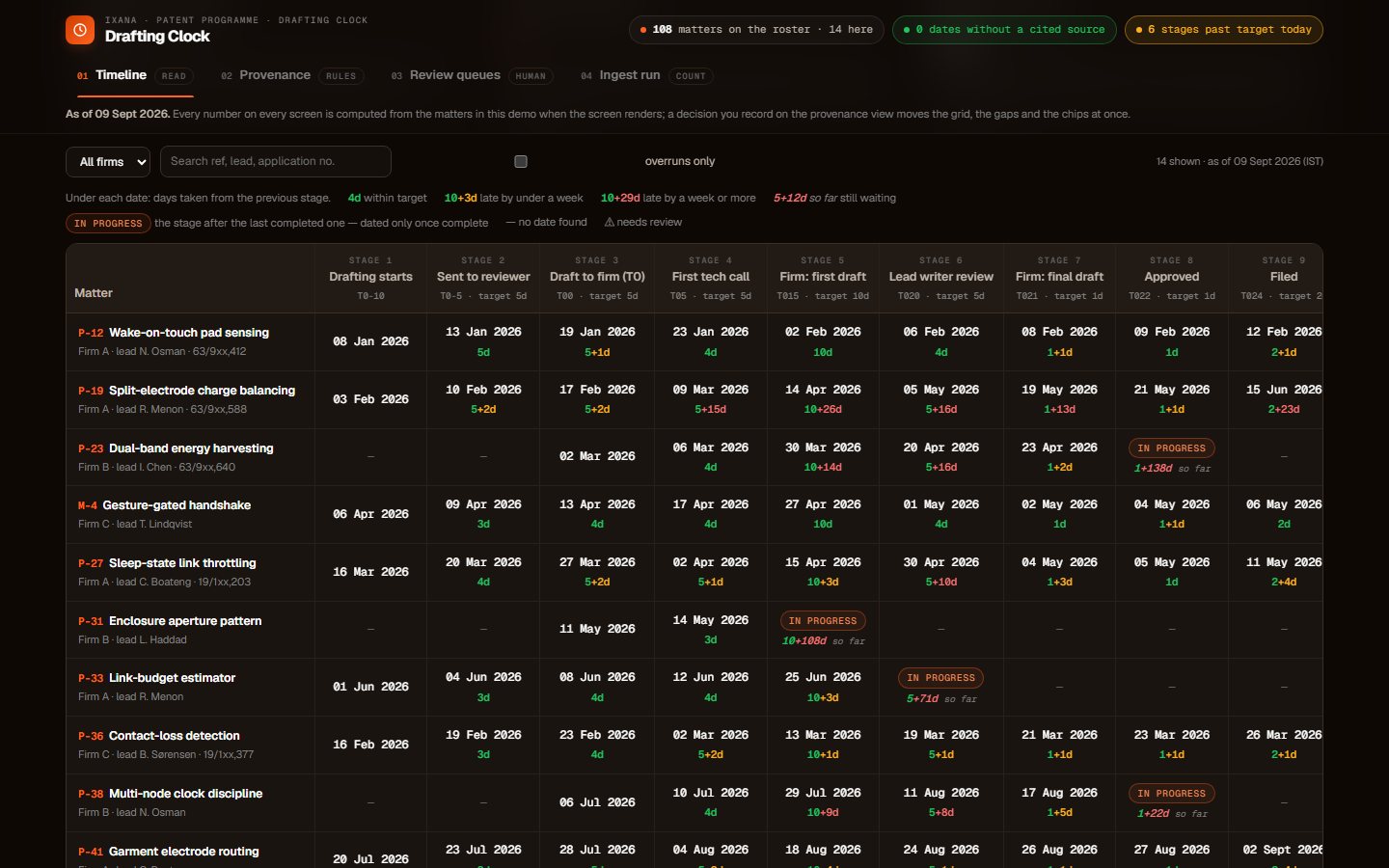
- 1A date is a cited message, or the cell stays empty. Every date is read from the mailbox, the calendars or a group chat, and the reader can open the message behind it. Twelve roster matters show nothing because nothing in the record says a stage happened — a dash, not an estimate.
- 2Targets were fixed before the first matter was read. T0 is the draft reaching the firm; the offsets are the plan's own. The colour is how far over the target, never whose fault — the fault lives on the card, with its citations.
- 3In progress is a definition, not a guess. The stage after the last completed one, until filed. An open review round is not complete, so its cell carries no date and the elapsed days keep running against the target.
- 4Every machine choice has a human undo. A winner was chosen by rule; on the provenance view a person can reject it, select another candidate or set a date by hand. Each is a decision with a name and a note, and the grid recomputes.
A working recreation of the drafting clock, not a mock-up: the nine-stage model, the T0 offsets, the selection order, the minimum confidence per stage and the citation rule are the real ones. Every matter, reference name, firm, person, subject line and message is synthetic. The deployed portfolio demo linked above carries the other five surfaces.Open the clock, then click a red cell ↗
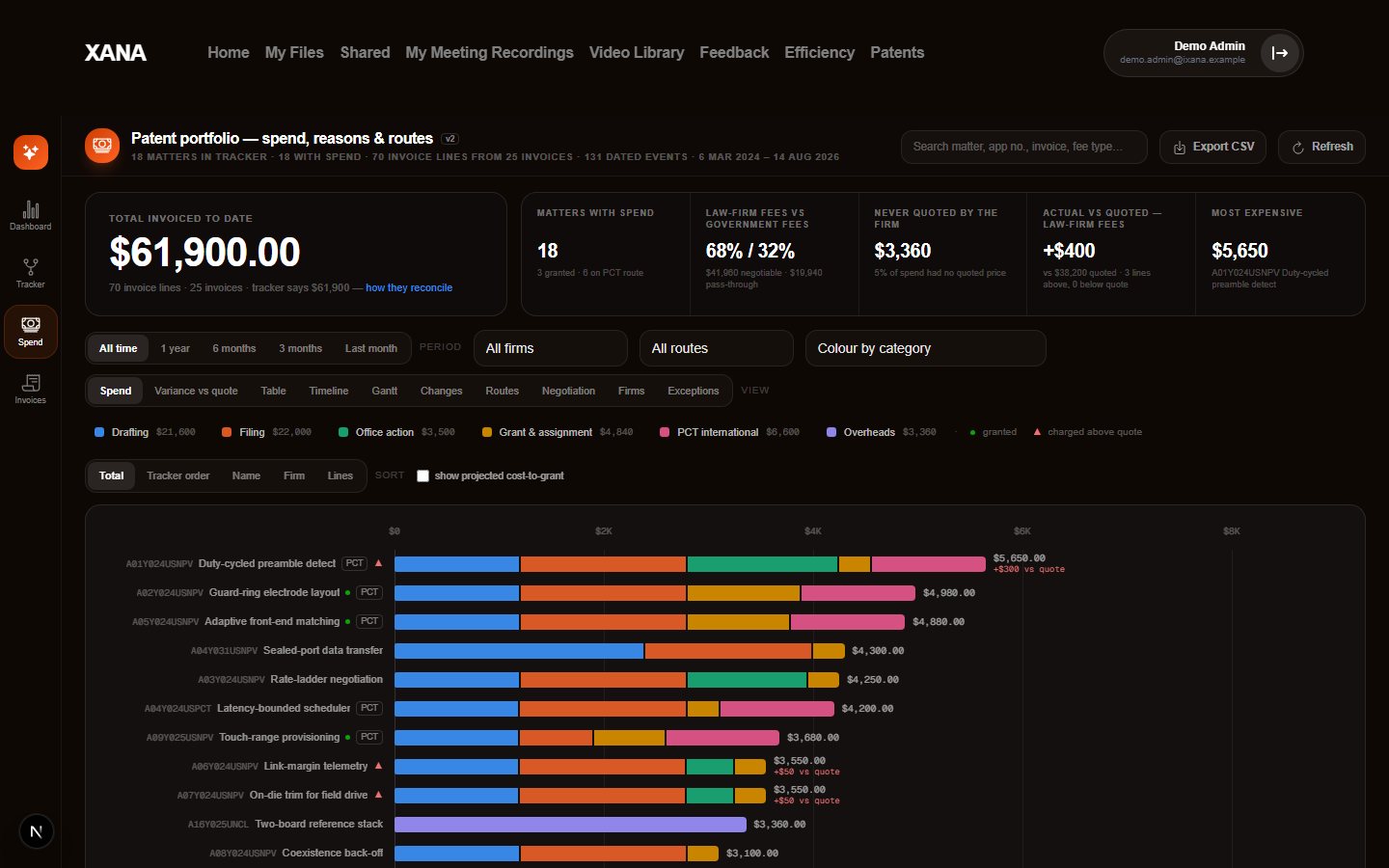
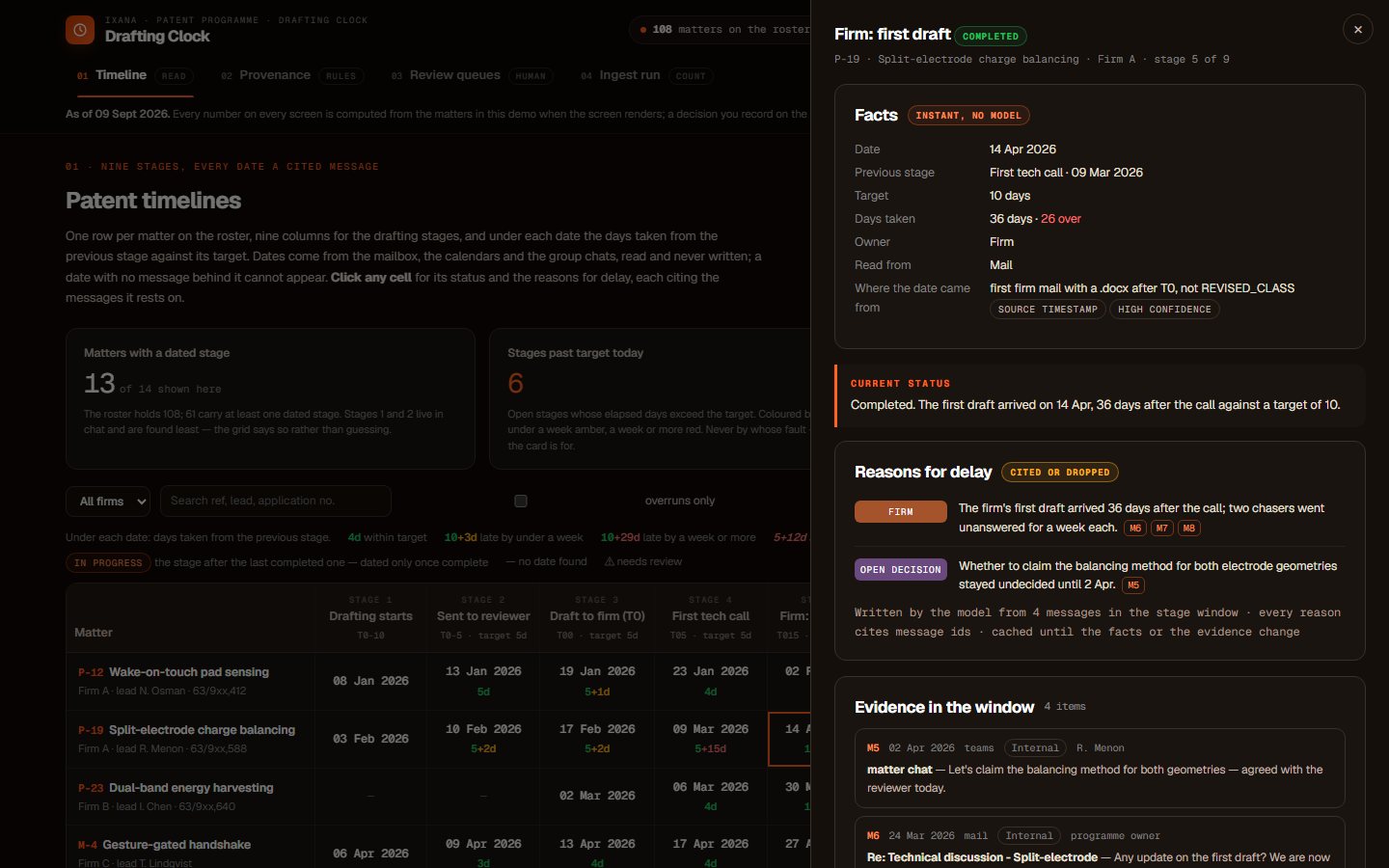
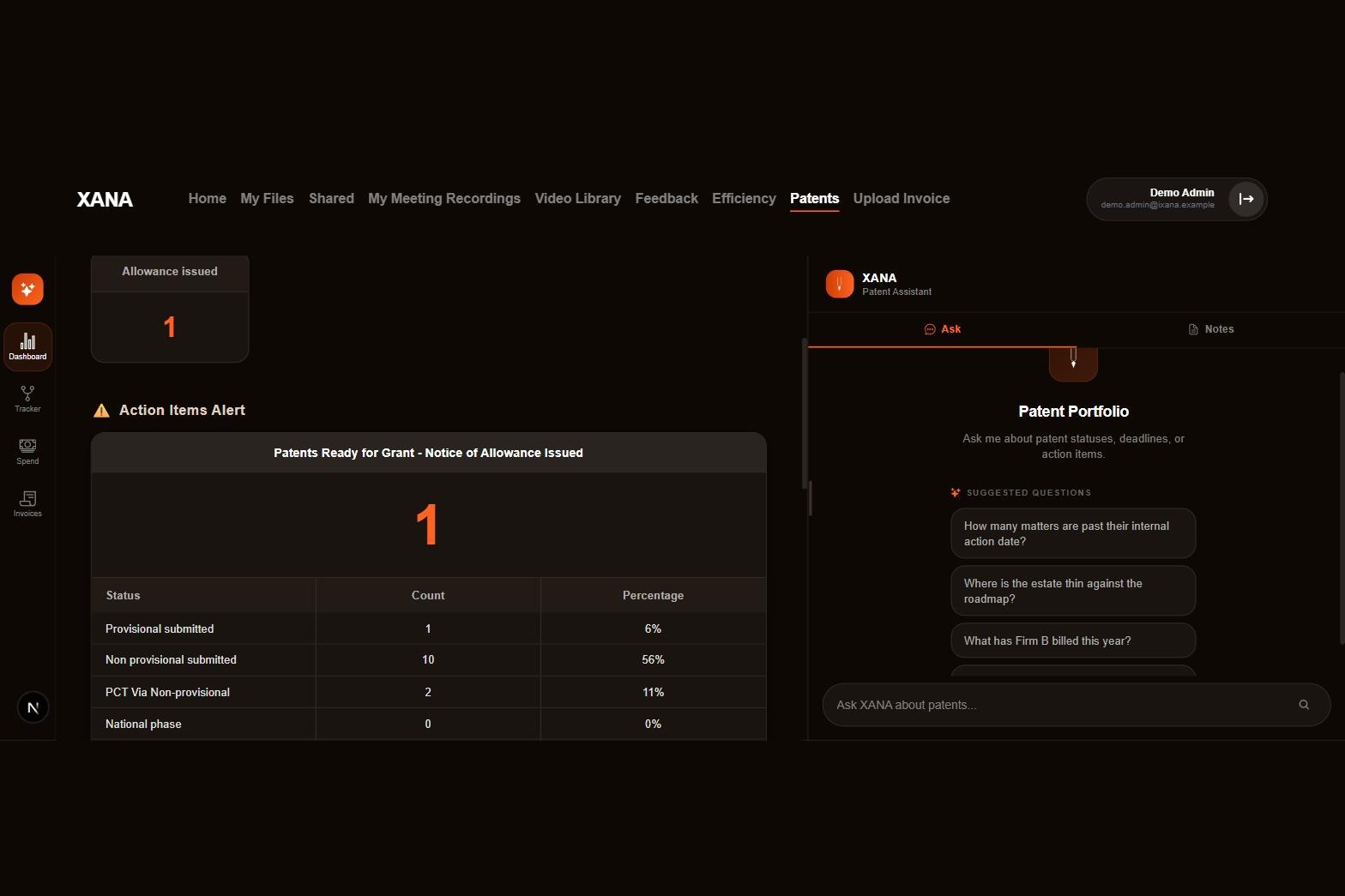
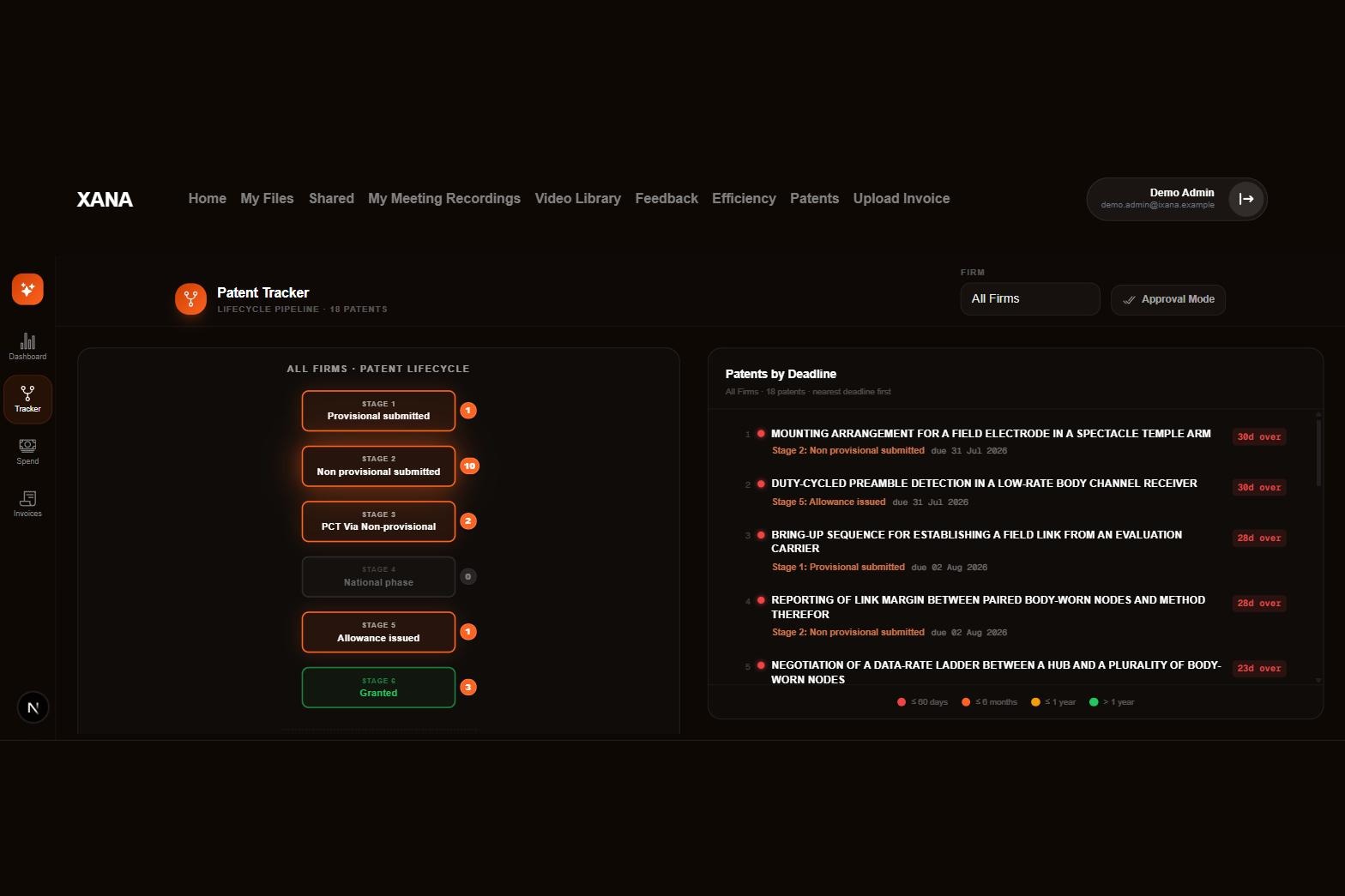
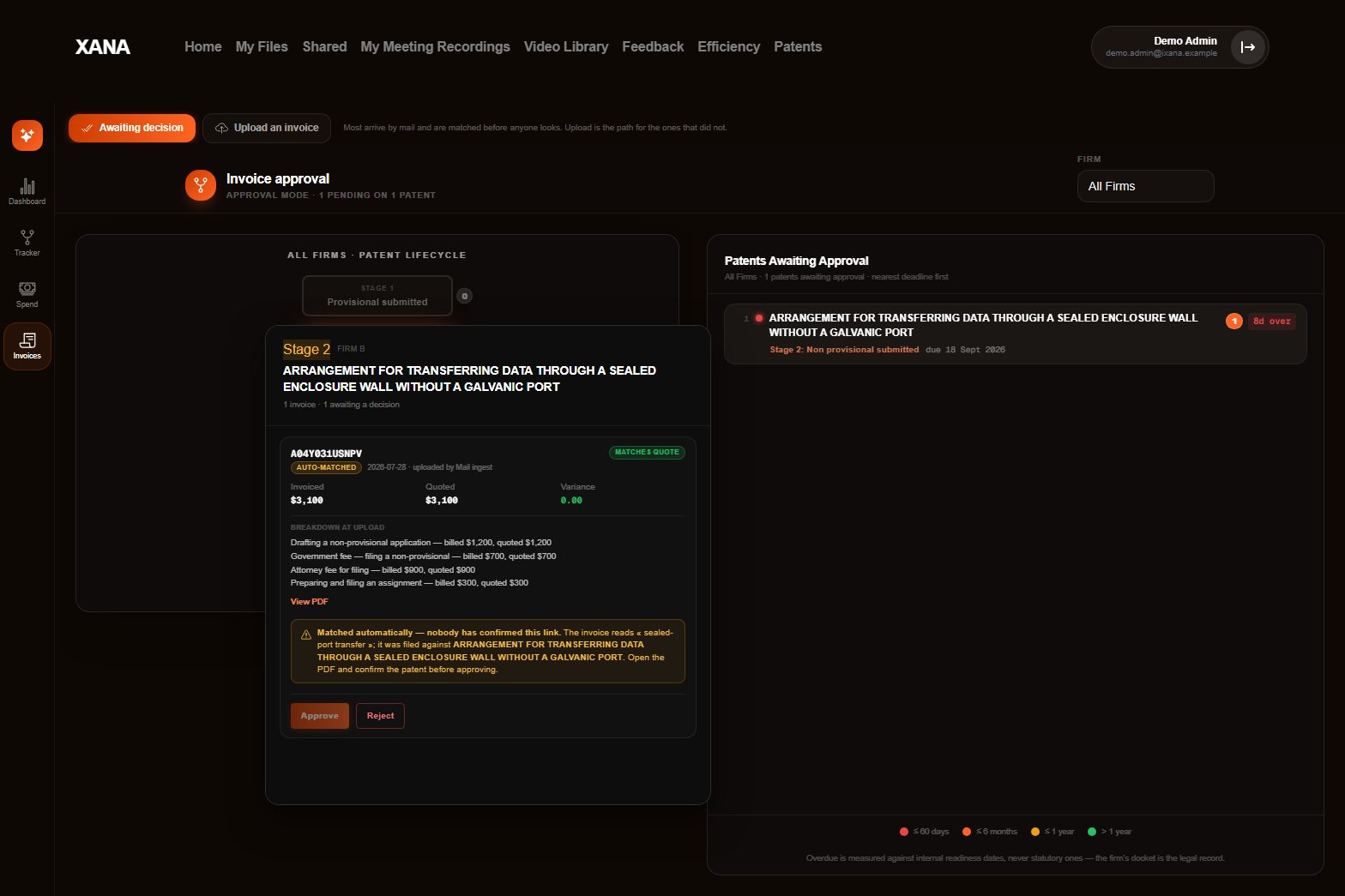
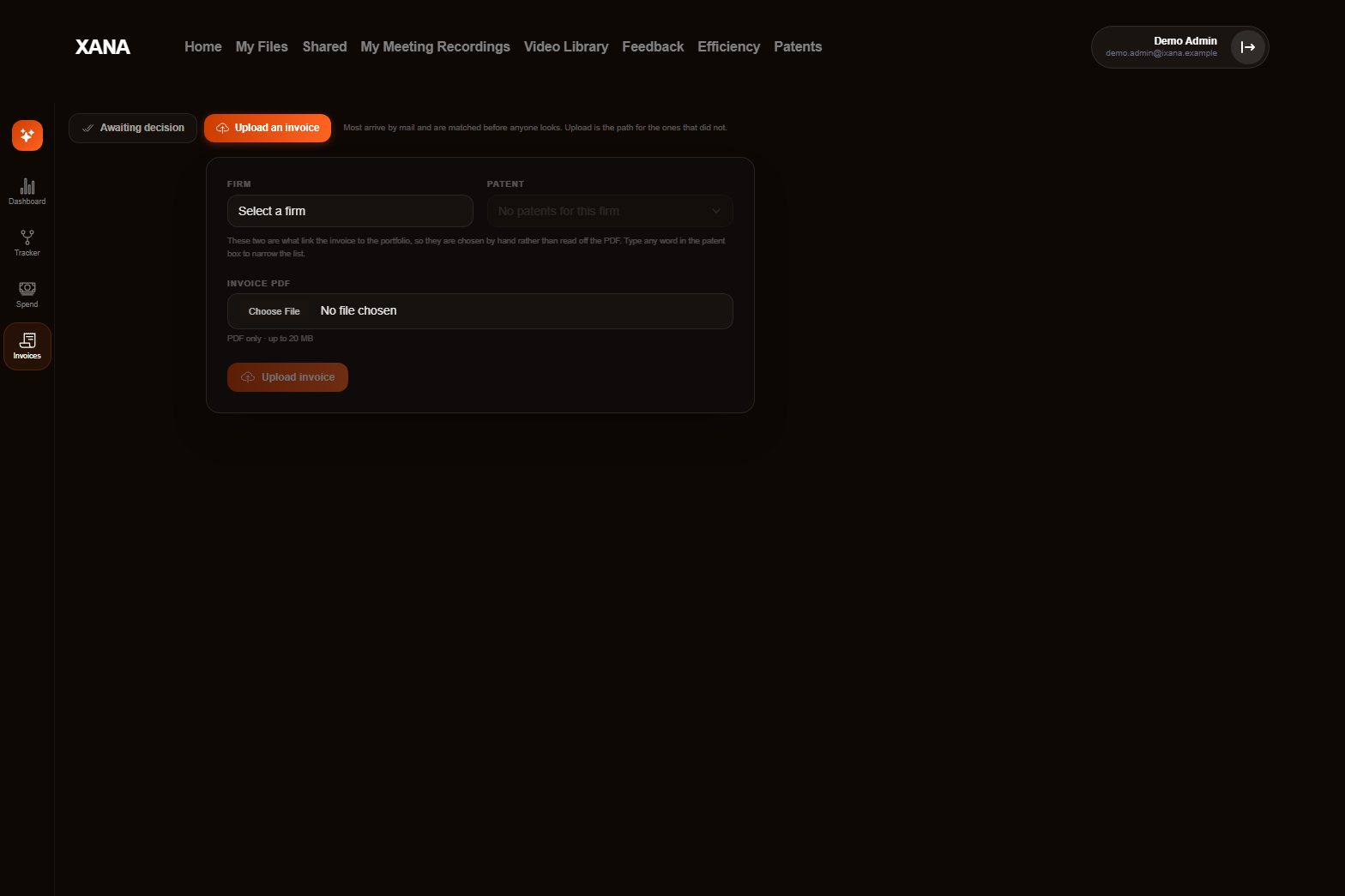
The other surfaces over the same spine, each link opening the screen its image shows — five on the deployed demo's synthetic portfolio, and the stage card from the drafting-clock recreation.
| Surface | Who uses it | The decision it carries |
|---|---|---|
| Mail-triggered spine | Nobody — it runs underneath | What can be automated at all: routing yes, dates never |
| Workbook sync | Nobody — it runs underneath | What one patent means: a family counts once, and the master is derived, never authored |
| Drafting clock | Me weekly; each firm, read-only | Which stage is past its target, by how much, and — from the record — why |
| Provenance and review queues | Me, when a rule stops | Whether a machine's match or date stands, decided by a person with a note |
| Spend, reasons and routes | Me at quarter end; each firm, read-only | Whether a matter is worth what it is costing — by stage, against the quote, and for what the rest of its route will cost |
| Lifecycle tracker | Me weekly; the founder before a review | Which matters are past their internal action date |
| Portfolio dashboard | Founder/CTO, and counsel on the monthly call | Where the estate is thin against the roadmap |
| Ask the portfolio | Engineering leads, ad hoc | Whether a question needs me in the room at all |
| Invoice approval | Me, then the founder | Whether the work billed matches the engagement |
| Invoice upload | Me, for anything the mail spine missed | Which matter an invoice belongs to, decided by a person |
System configuration — mail-triggered extraction into 6 lifecycle stages and 5 technology categories, plus an explicit unclassified stage · one internal matter identity mapped across 3 outside firms · portfolio counts deduplicated by family across 3 source workbooks, taking each family’s most recent row · eTag then content-hash change detection on a 60-second poll · master view rebuilt in place through the workbook API with annotations preserved and every write verified · spend held as an invoice-line ledger — 1 row per line, each carrying its fee type, who keeps the money, the jurisdiction, the firm’s quoted price and a written reason · variance reported on law-firm fees only, government fees passed through · national-phase deadlines mirrored from the firms’ dockets, never computed · forward budget from the firms’ country quotations, labelled estimate · invoice lines matched individually against the quoted schedule · deadline colouring at 60 days, 6 months and 1 year · no statutory date computed anywhere in the system · nine-stage drafting clock with T0 offsets −10, −5, 0, +5, +15, +20, +21, +22 and +24 days, read GET-only from one mailbox, the calendars and the group chats · alias match at an 85-point threshold · winners chosen by rule in chronology order with a minimum confidence per stage · stage cards cite message ids or drop the reason · 0 writes to any source
07Tradeoffs
| Tension | What I chose | What it cost |
|---|---|---|
| Cycle time vs inventor time | Front-load the fields counsel asks for anyway; never chase for more | Some disclosures reach counsel thinner than they could be and come back with questions |
| Coverage vs discoverability | No automated freedom-to-operate scoring, on the same reasoning that cut drafting | We have no systematic read on third-party risk; it stays a question we ask counsel, one product at a time |
| One view vs one authority | Mirror counsel’s docket; compute only internal readiness dates | Two date systems on one screen, and a permanent explaining job for anyone new |
| Automation vs attributability | Machine-made links stay marked until a person confirms them | Every invoice needs a human minute before approval, and a backlog forms whenever I travel |
| Correctness vs a record that can be testified about | Report discrepancies, never correct a source workbook | Known errors sit uncorrected until a person applies them, sometimes for weeks |
| A derived view vs someone’s working surface | Derived columns rebuild every cycle; the annotation column is preserved untouched | The sync halts whenever a rebuild would drop an annotated row — twice so far, both justified |
| Evidence-only dates vs coverage | A stage is dated only by a message that says it happened | Stages that live in chat are found for barely a third of matters; the grid shows the gap rather than an estimate |
08Impact and outcomes
We agreed before build that this failed if any date the system showed disagreed with counsel's docket at the weekly reconciliation twice running. It has not happened. The guardrail was inventor minutes per disclosure: cycle time bought with engineering hours is not a win. The clock adds one early signal.
How we counted. An active matter is a filing with at least one open action owned by a named person and dated inside ninety days. It excludes granted patents with no maintenance action due, abandoned matters, and unconverted provisionals past their window. We count the matter, not the document — a family of four counts once.
09What I'd do differently
I built the mechanism before I wrote down the strategy. For a year the filing decisions lived in my head and in conversations, while what got documented was the plumbing. How a tapeout maps to a filing decision is still the part I cannot hand over.
And I would have started the clock a year earlier. The overrun it shows most — the firm's first draft — was the one everyone felt and nobody measured; the tail past sixty days is inventor availability in a tapeout crunch.